
31 March 2026
03 March 2026
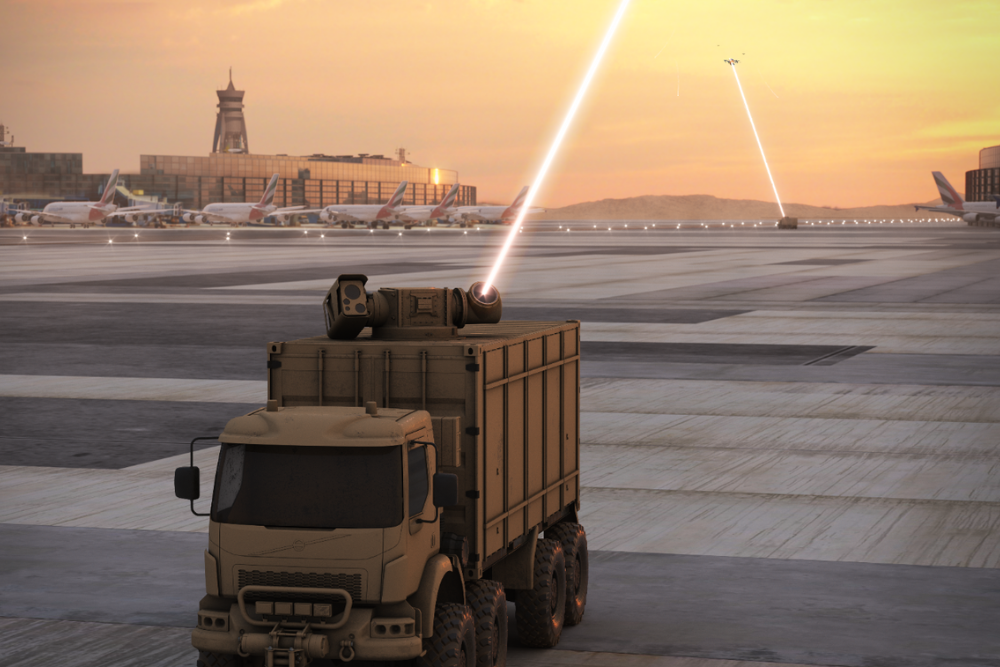
Laser and microwave weapons are among "soft kill” methods of destroying Unmanned Aircraft Systems gaining relevance in the U.S. and European defense industry. Defense manufacturers worldwide are producing high energy laser weapons, microwave weapons or both, including Raytheon, AeroEnvironment, Boeing, Northrup Grumman, Elbit Systems and many others.
The technology is in demand due to threats posed by drone swarms and incursions.
“Many countries are now working on increasing their capacity to deal with this type of threat,” said Federico Borsari, non-resident fellow with the Transatlantic Defense and Security Program of the Center for European Policy Analysis.
“Law enforcement agencies across Europe are working to improve their ability to deal with this threat. They are either buying equipment or doing drone training.”
Both weapons systems create invisible forces that make drones literally drop dead using different methods.
How Laser Weapons Systems Work
Lasers perform especially well when used against vertical targets, according to Dr. Andreas Schwer, Managing Director and CEO of Australia-based Electro Optic Systems, which specializes in producing high energy laser systems.
The lasers work in the optical domain and deliver a highly precise effect that sets them apart from microwave weapons, he explained.
“You burn physically a hole through the drone, through the target, within milliseconds," said Schwer.
"Obviously because of the extreme overheating syndrome, the heat impact, it starts either to burn, to deflagrate, or if there is anything which could explode in the inside, it will explode because of the heat impact.”
The beams become sharper weapons in cold, clear weather. “The lower the temperature and the lower the air humidity, the better the laser weapon is. The colder the air, like in the Arctic, the better it will work," Schwer said.
Schwer said that his systems can take out 30 drones per minute, and have capabilities that are rapidly evolving. While the company is getting lots of inquiries for naval versions, there is high demand for lasers to protect critical infrastructure on land–a trend he expects will continue.
How Microwave Weapons Systems Work
Microwave technology takes an alternative approach to killing drones by creating electromagnetic force fields, explained Andy Lowery, CEO of Epirus Inc., which specializes in producing high-power microwave weapons systems.
“Laser systems are like a wizard shooting a lightning bolt out of their hand. We do more of like a fog spell,” Lowery said. “We make an interference field."
Weaponized electromagnetic interference can be used to create disruption zones against drones, making robust drone communication technology irrelevant.
“We don’t use any of the outside signals coming into it," Lowery said. "We go right into the boards and into the electronics.”
Past theories saw the science used in a different and a more limited manner, Lowery said. He said the company’s systems use what is called a narrow band approach to create an intense, pulsing wall of energy.
The technique can also stop car engines and boat motors, having an effect similar to the so-called “blue screen of death" on computers, Lowery said. The company works steadily with the U.S. military, including U.S. Special Operations Command, and Lowery said it is seeing a spike in interest on an international scale.
Silent Drone Killers
Although they kill drones differently, both laser and microwave weapons technologies offer similar advantages. Both types of system kill a wide variety of drones, including tethered drones.
They also cut down drones in silence.
“The laser weapon you do not see and you do not hear," Schwer said. "The drones just fall down.”
The use of weapons that cannot be detected with the naked eye reflect the increasing sophistication of modern warfare.
“Cyber has had issues with what we call swarm attacks, or one-to-many attacks, where you’re trying to defend one against many attacks coming in simultaneously,” said Lowery.
“That is the war that we’re fighting. But we’re fighting it in the physical domain now.”
Near-Term Kinetic Methods
As global interest in laser and microwave weapons continues to grow, Borsari contends that kinetic drone interceptors–including small drones that chase and kill other drones–will remain prevalent in the near-term as “one of the most promising areas [of counter-drone defense], because drone interceptors are very cost-effective."
Despite the advantages they offer in cheap manufacturing costs, however, Borsari acknowledges that kinetic drone interceptors introduce challenges to manpower.
“Depending on the area’s characteristics, these drone interceptors often require an operator to be used," he said.
“That’s the problem Ukraine is facing. They are producing drone interceptors at scale, but they don’t have sufficient operators to use them. Training is not keeping up with the rate of production."
Drones have introduced a wide variety of threats into the modern defense landscape that pose challenges to many conventional weapons. As technology continues to evolve, microwave and laser weapons systems are steadily gaining traction as anti-drone solutions, offering alternately what might be called a sword or shield approach to defend fixed positions and showing potential for more advanced military use in the future.