16 February 2026
08 December 2025
By Navid Linnemann, Defence Network
The Australian manufacturer of weapon stations and laser systems for drone defense claims to have never lost a live-fire exercise – not even in Israel. In this interview, CEO Dr. Andreas Schwer explains the source of this accuracy and why Electro Optic Systems (EOS) wants to expand its market presence in Europe, particularly in Germany. Also discussed are EOS's technological lead, pricing for the Netherlands, and its unique capabilities for engaging satellites.
EOS is based near Canberra in Australia. What is the threat level Down Under, while in Europe drones are increasingly being observed over critical infrastructure or military bases, and Russian drones are finding their way into EU airspace?
In Australia, the threat posed by drones was long considered low. People felt thousands of kilometers away from potential adversaries. Overall, the situation is not comparable to that in Europe, although there have been isolated sightings.
However, this understanding changed fundamentally when Ukraine attacked Russian airports deep inland. This made it clear that even smaller terrorist groups could easily launch hundreds of drones near an airfield and cause significant damage.
In response, the government launched the LAND 156 program to introduce a standardized counter-UAS system. It was allocated 1.3 billion Australian dollars (approximately 750 million euros) and the project was put out to international tender.
EOS did not bid as the main contractor, but offered our effectors to around a dozen partner companies. One of them won the tender. We are now an integral part of the selected team and will present the prototype system in a live-fire test in the Australian desert on December 4th.
On your website you write: "No one kills drones like EOS." That's a very confident statement. What is your reasoning behind it?
We have never lost a single comparative shooting competition in our entire company history. One took place this year in Israel. Only Israeli consortia were permitted to participate.
Together with our local partner Israel Aerospace Industries (IAI), we competed against local rivals – including two internationally renowned companies – and won this shooting competition as well. Our kill rate was twice that of the next best competitor.
To win so decisively in the home country of two key competitors is a clear vote of confidence and an outstanding demonstration of performance.
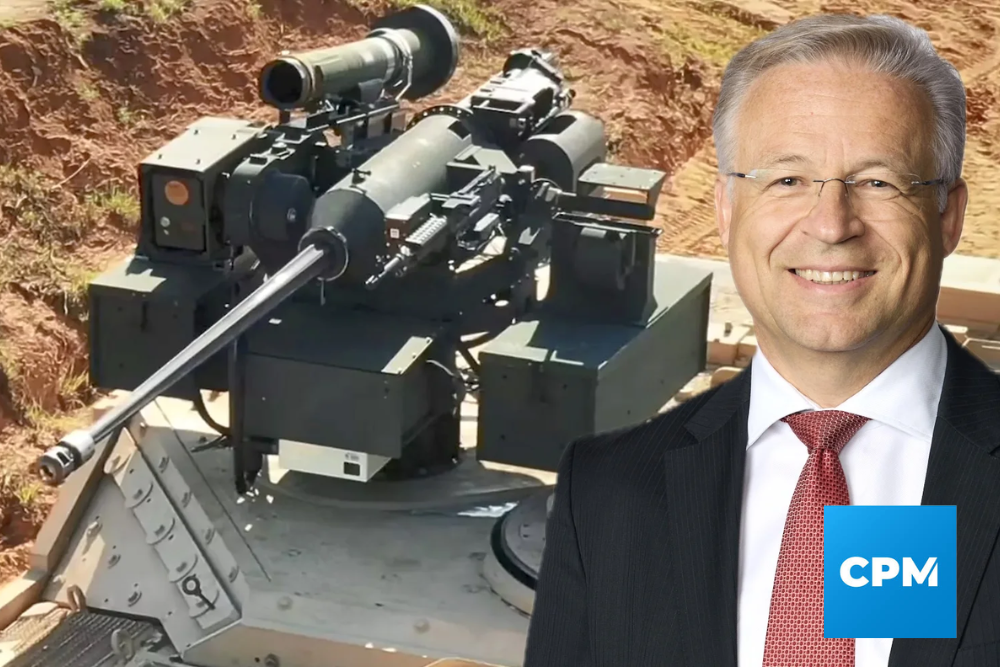
We also won by a wide margin at the US Army's most prestigious live-fire exercise in April of this year. Subsequently, we received a contract from the US Army, which will likely make us their preferred C-UAS standard solution. The US combat vehicle fleet will be equipped with an EOS R400 Slinger in a semi-autonomous special configuration.
At the same time, the British government has even asked our local competitor to enter into a licensing agreement with us, so that our product will be manufactured locally by our new partner and offered on the British market. A similar situation is currently unfolding in France.
Ultimately, we typically achieve around 30 percent better performance, meaning a higher hit rate over long distances than any of our competitors. We are very proud of that.
Where does this higher accuracy in EOS come from?
This dates back to the 1980s. At that time, we were a partner of the US government in the Strategic Defense Initiative (SDI), the so-called Star Wars program. Together with American partners, we developed laser weapon systems for combating satellites and missiles. During this period, we built up our precise tracking and detection capabilities.
When the program was discontinued in 1990, we further developed the technology for ground-based applications. Today, we can detect every movement in space and even track a two-euro coin from tens of thousands of kilometers away. We have adapted this technology for ground-based systems. Even today, we develop and manufacture all these key technologies in-house – instead of purchasing them from third-party suppliers like most of our competitors.
EOS is therefore confident, backed by proven track record and experience. We've been discussing the Slinger weapon station. What can you tell us about the rest of their portfolio?
We have the world's broadest portfolio of weapon stations – from very small, mobile systems, such as our EOS R150, to large, very powerful systems that can easily keep up with a full-fledged medium-caliber turret.
Our EOS R800 offers a performance level similar to a Puma or Lance turret – but even in its protected version, it weighs only a third and costs at most a quarter. Its low weight also allows it to be integrated into significantly smaller vehicles.
Our second area of expertise is high-energy laser weapons for the defense against drones and small aircraft. The development is based on the Star Wars program of the 1980s and was subsequently continued using our own resources. Today, we are the only company worldwide that can offer 100 kW systems and manufacture them locally in the customer's country. This is only possible because we are the only supplier that holds all the necessary intellectual property rights.
The related third area is Space Warfare. Here, we can offer our customers systems that enable them not only to monitor enemy satellites but also to actively combat them from the ground – in three stages: temporary blinding, destruction of the sensors, and finally, disabling the entire satellite.
This is preferably done from the ground – either stationary or mobile – but can also be done from space in the future, if desired. EOS is the only company outside the USA that can offer such systems.
What services are we talking about here?
To blind satellites, laser power levels of around 1 kilowatt are sufficient. The challenge lies less in the power than in compensating for atmospheric disturbances and stabilizing the laser beam.
Destroying a satellite requires hundreds of kilowatts. This was not possible before, but today we can offer these services.
Are these also the capabilities of EOS's anti-drone lasers?
Not quite. Successfully combating drones requires laser power outputs between 50 and 150 kilowatts. For example, in August we became the first company worldwide to sell a 100-kilowatt laser weapon to an export customer, specifically the Dutch government. The Netherlands aims to establish itself in Europe as a leading user of highly innovative laser weapons.
And what kind of costs are we talking about?
The laser was sold for €71 million – including development, localization, and integration costs, which will be eliminated in future systems. In small quantities, the system price is between €45 and €50 million, while in large series it is around €30 million – roughly the same as a Leopard 2 tank. We expect that in the medium term, states will procure large quantities to protect their entire critical infrastructure with laser weapons.
The Apollo laser from EOS delivers 150 kW. A competing German product was recently tested at 20 kW. That's a significant difference, isn't it?
Yes, and that's one of the reasons why we're shifting our focus to Europe. The market potential here is enormous, with moderate competition. Besides the 20 kW system from our German competitor, a British consortium is developing a 50/60 kW system, which won't see its first deliveries until 2028.
In France, the local industry is working with a 5 kW system and has a mandate to increase it to 50 kW by 2031. We can already scale up to 150 kW. If a customer orders such a system today, we can deliver it as early as 2027. This gives us at least a 5-year lead over our nearest European competitor.
In the market for 100 kW laser weapons, we at EOS have only one real competitor: an Israeli industrial consortium consisting of three companies. Otherwise, no one else in the world offers 100 kW systems.
Our systems are not only "off the shelf"—order today and you'll receive a 100 kW laser in 2027—but also affordable. For comparison, we're offering the German government our systems at a significantly lower price than our local competitor. Our promise: "Double the performance for half the price in half the time." And all this with complete localization of the technology and manufacturing in Germany.
Through your partnership with Diehl, you already have a presence in Germany. How do you plan to expand this presence? What do you offer in Germany?
Together with Diehl Defence, we offered our R150 system for the German Armed Forces' unprotected transport vehicles (UTF) . The aim of the tender is to equip all of the German Armed Forces' heavy logistics vehicles with remotely controlled weapon stations – a total of up to 4,200 systems. We submitted a very competitive bid and hope to be awarded the contract.
Besides a rapidly growing market for anti-drone systems, we are at the beginning of a global boom in systems for protecting our own space infrastructure and combating enemy satellites. The US government has launched the $175 billion Golden Dome program , in which we are also involved. However, our core market will be Europe.
We will not offer Europe a Golden Dome system – that is beyond our capabilities. But we can offer a capability of paramount importance to European governments: the ability to disable any enemy satellite, both from the ground and from space. In Germany, we are working closely with our partner OHB on this and will also present this offer to the German government.
Thank you very much for the interview, Dr. Schwer.
Translated from the original German publication.