22 October 2026
22 October 2026
Insights from the EOS Defence Leaders Breakfast, Land Forces 2026
The next advantage in defence capability will not come from developing the most advanced technology. It will also come from how quickly we can adapt and field such technologies.
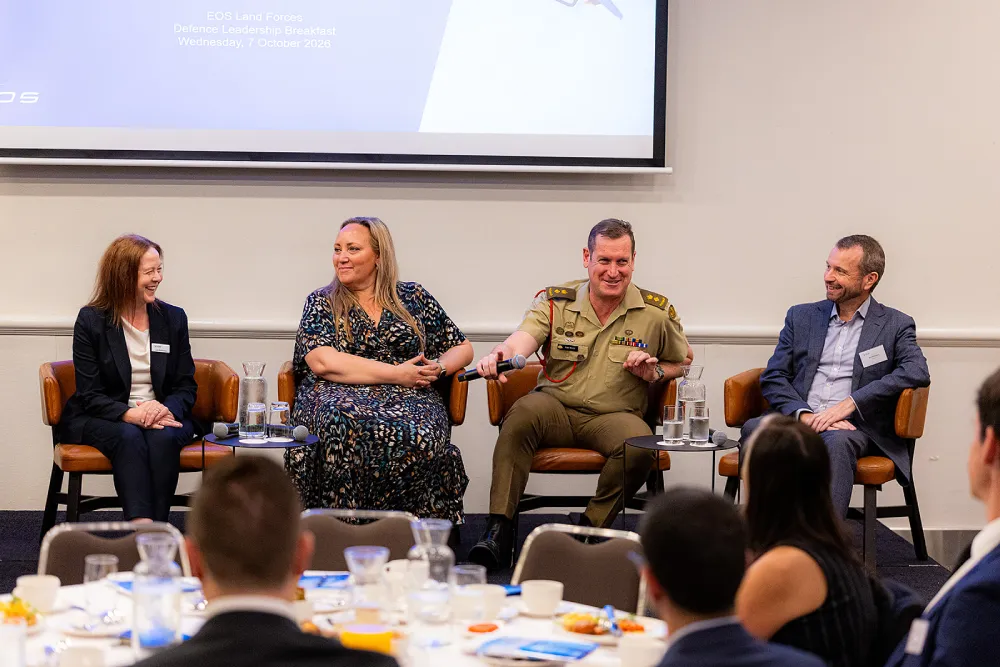
This was the central challenge explored at EOS's Defence Leaders Breakfast at Land Forces 2026, bringing together Defence and industry leaders to discuss how Australia can keep pace with an evolving threat.
In his keynote, LTCOL Josh Mickle, Project Director – LAND 156, highlighted how drones are changing modern warfare, with technologies and tactics evolving in months, sometimes weeks.
LAND 156 demonstrates a different approach to capability development. Rather than acquiring a fixed solution, Defence is building an integrated capability designed for continuous improvement, with technologies tested, introduced and upgraded as threats evolve.
But the broader discussion highlighted that moving faster requires more than changing acquisition processes. It requires changing how Defence and industry work together.
Three themes stood out.
1. Engage earlier. Too often, industry is brought into the conversation once requirements have already been defined. Engaging earlier, including with second- and third-tier suppliers, allows those closest to the technology to help shape practical solutions from the outset.
This extends beyond design. Industry needs visibility of future demand to invest in people, equipment and production capacity. At EOS, around 80% of our suppliers are Australian. As our business grows, we are working with them to anticipate requirements and build the capacity needed to deliver. Sovereign capability depends on the strength of the entire supply chain, not just the company delivering the finished system.
2. Rethink risk. There is an important distinction between delivering capability that is safe and operationally effective, and waiting until every possible requirement has been met. In a rapidly changing threat environment, delay carries its own operational risk.
The discussion challenged how Defence and industry can agree on minimum requirements, test capability in realistic conditions and introduce improvements progressively. This requires clarity around who accepts risk, how it is managed and when a capability is ready to be fielded.
3. Build genuine partnerships. Continuous adaptation depends on keeping the end user needs at the forefront of any discussion, trusted communication, direct operational feedback and the confidence to challenge assumptions.
The panel all had examples of why the relationship between operators and industry cannot end when equipment is delivered. Feedback must inform development, testing and the next generation of improvements.
For Australia, sovereignty also plays an important role. It is not about doing everything ourselves, but retaining the knowledge, engineering authority and trusted partnerships that give us the freedom to act when circumstances change.
LAND 156 offers one example of what is possible when capability is designed to evolve. EOS's experience reinforces why those principles matter in practice.
The bigger question is how we take these lessons beyond individual programs and make continuous adaptation part of the way Australia develops, delivers and sustains Defence capability.