19 October 2026
07 September 2026
The challenge is not only how to stop a drone, but how to connect sensors, command and control and effectors quickly enough to respond. The growing use of low-cost UAS in large numbers also puts pressure on the economics of defence. Defensive systems need to be able to sustain repeated engagements without imposing an unsustainable cost for every target defeated.
EOS is bringing these elements together through an integrated architecture combining AI-enabled command and control, kinetic effectors and high energy laser technology. NiDAR provides the intelligence and integration layer, while Slinger and Apollo provide different hard-kill options.
Detection can draw on radar, electro-optical sensors, radio frequency monitoring and other sources. Bringing those inputs together into a clear operating picture and connecting that information with available countermeasures is critical.
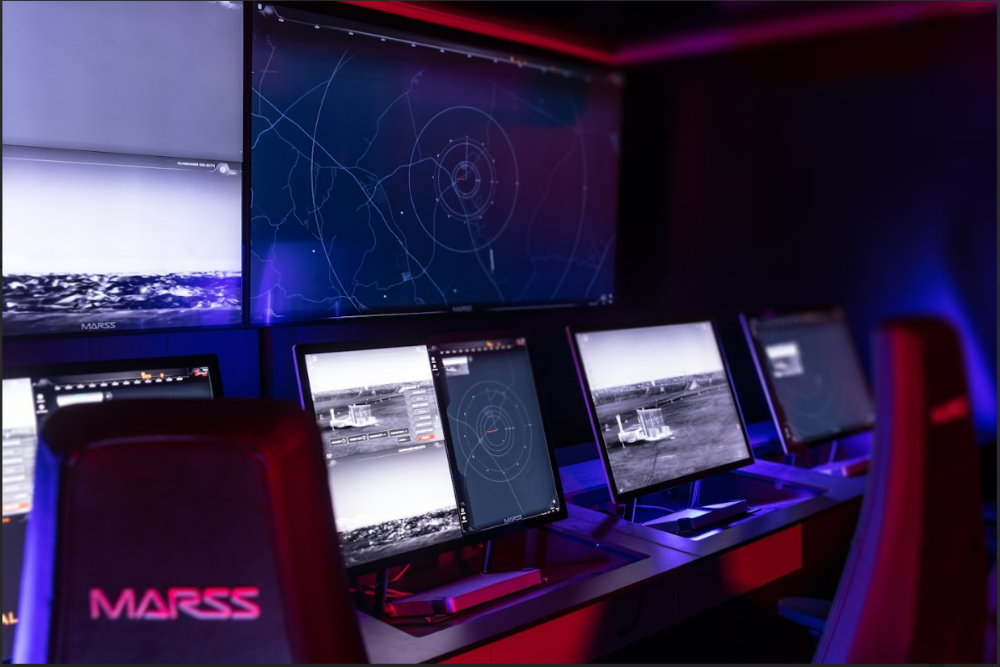
NiDAR CUAS, developed by MARSS, brings these functions together, connecting sensors, command and control and countermeasures. MARSS is now part of EOS, adding the software and command and control layer that brings EOS’ effectors into a wider system.
Its sensor-agnostic architecture allows different sensor technologies to be integrated according to the operating environment. Machine learning supports threat classification and behavioural analysis, with automated tracking and camera handover.
NiDAR can track more than 1,000 objects in real time, including friendly assets.
It connects this operating picture with available countermeasures, supporting selection of the response according to the target.
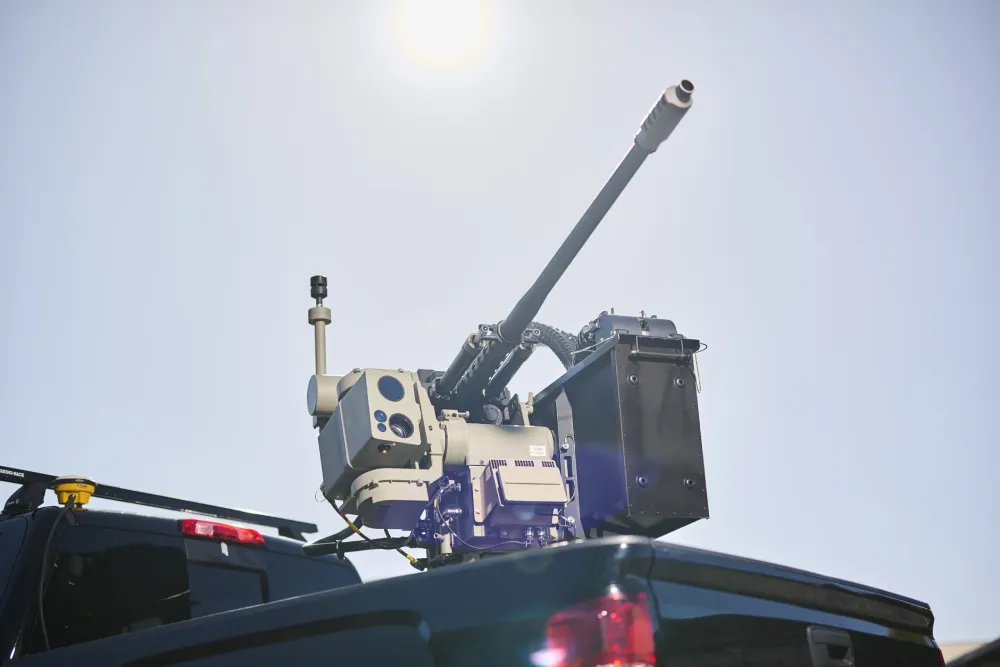
No single effector can address every UAS threat.
Kinetic systems provide a hard-kill response. High energy laser weapons add the ability to engage targets rapidly and repeatedly, with magazine depth determined primarily by the available power supply.
Slinger was designed specifically for CUAS operations, combining precision tracking with a 30 × 113 mm cannon and specialised proximity-sensing ammunition.
The system can track and engage moving drones beyond 800 metres. Weighing less than 400 kg and fully stabilised for on-the-move operations, Slinger can be mounted on military or commercial vehicles or deployed at fixed sites.
It can operate independently or connect with centralised command and control. Slinger supports multiple ammunition types and can also engage ground targets at ranges out to 2,000 metres.
As the number of incoming UAS increases, however, engagement rate, magazine depth and cost per engagement become increasingly important.
Apollo is EOS’ high energy laser weapon, designed to protect critical assets against individual UAS and drone swarms.
Operating at scalable power levels from 50 to 150 kW, Apollo is designed to neutralise Group 1–3 UAS. Against Group 1 UAS, it can deliver more than 20 kills per minute.
Apollo provides more than 200 stowed kills using internal power. When connected to external electrical power, the number of engagements is unlimited.
This allows operators to respond to large numbers of UAS without consuming conventional ammunition for every target.
Apollo complements rather than replaces kinetic systems and can operate independently or alongside kinetic effectors.

CUAS capability also needs to keep pace with changes in UAS technology, autonomy and tactics.
A fixed combination of sensors and effectors can become limiting as the threat changes. The ability to incorporate different technologies gives operators greater flexibility to adapt over time. NiDAR’s sensor-agnostic approach allows new sensors and countermeasures to be integrated according to the threat and mission.
This extends beyond Slinger and Apollo. Other effectors can also be integrated, including autonomous interceptor technologies. For European armed forces, that flexibility is important across a wide range of operational environments. Recent conflicts have demonstrated the use of UAS for surveillance, targeting and attack, as well as the speed at which platforms and tactics can change. The requirement extends from protecting deployed forces to defending bases, command posts, logistics infrastructure and other critical assets. New CUAS capability also needs to work within existing command and control and air defence structures.
CUAS is becoming less about selecting a single system to defeat a particular type of drone and more about building an integrated capability that can respond to different threats, at different scales and in different operational environments. As the threat continues to change, the ability to adapt will be as important as the capability fielded today.
This article first appeared on MILMAG.