14 September 2026
14 September 2026
This article first appeared in Polish on defence24.pl translation by Google Translate.
The Apollo laser system presented at MSPO 2026 allows for attacking foreign drones at the speed of light and neutralizing them cheaply and safely.
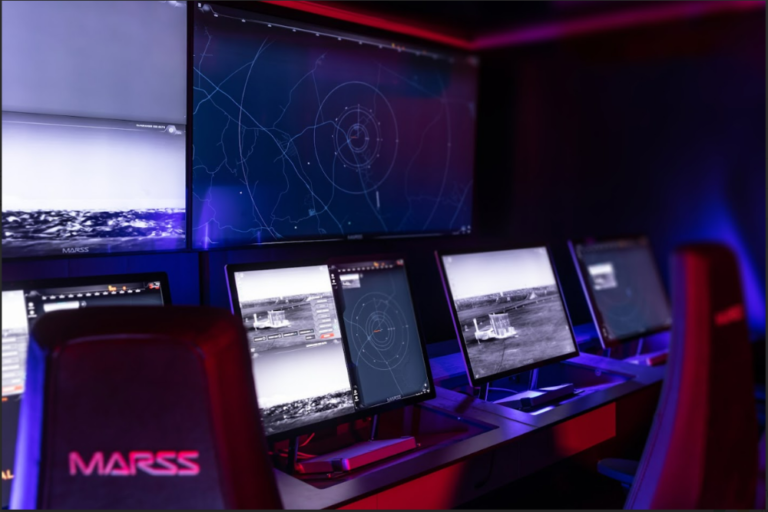
During the 34th International Defence Industry Exhibition, which takes place from 8th to 11th September 2026 in Kielce, the Australian company EOS (Electro Optic Systems) will present its comprehensive and multi-layered approach to combating unmanned aerial vehicles, which combines detection, command and control with kinetic effectors and a laser cannon.
In the case of effectors, the scalable Apollo-type HELW (High Energy Laser Weapon) laser, with a power output of 50-150 kW, deserves special attention. This solution is particularly useful in an era when drones, thanks to artificial intelligence, can autonomously reach a designated area, search for a pre-defined target, and attack it without contact with an operator or access to a satellite navigation system.
In such a case, all types of jamming devices become useless, leaving only destructive effectors. Previous research has shown that the fastest means of combating drones is energy weapons, as the attack reaches the target at the speed of light. Furthermore, once a drone is destroyed, only its debris falls to the ground, not the missile or rocket used to destroy it.
It's also important to remember the costs of countering drones, which, in the case of lasers, are essentially limited to the cost of electricity required to power the laser system. The EOS Apollo system also offers these advantages. However, it's not considered a standalone system, but rather a component of a multi-layered NiDAR system that detects, identifies, reports, and neutralizes threats.
It is a ready-made system that provides:
The kinetic effectors proposed by EOS include:
The Slinger system is based on the 30mm Bushmaster M230LF cannon. It is an autonomous weapon module that, weighing approximately 400 kg, can be mounted on various types of combat vehicles. Thanks to its own optronic sensor, the Slinger can engage drones at ranges exceeding 800 meters.
The system's effectiveness is enhanced by the use of lightweight 30mm Proximity Sensing Ammunition (PSA) ammunition, which utilizes proximity fuses that initiate the fragmentation warhead ahead of the target. The system can also be used to engage ground targets at ranges up to 2,000 meters.
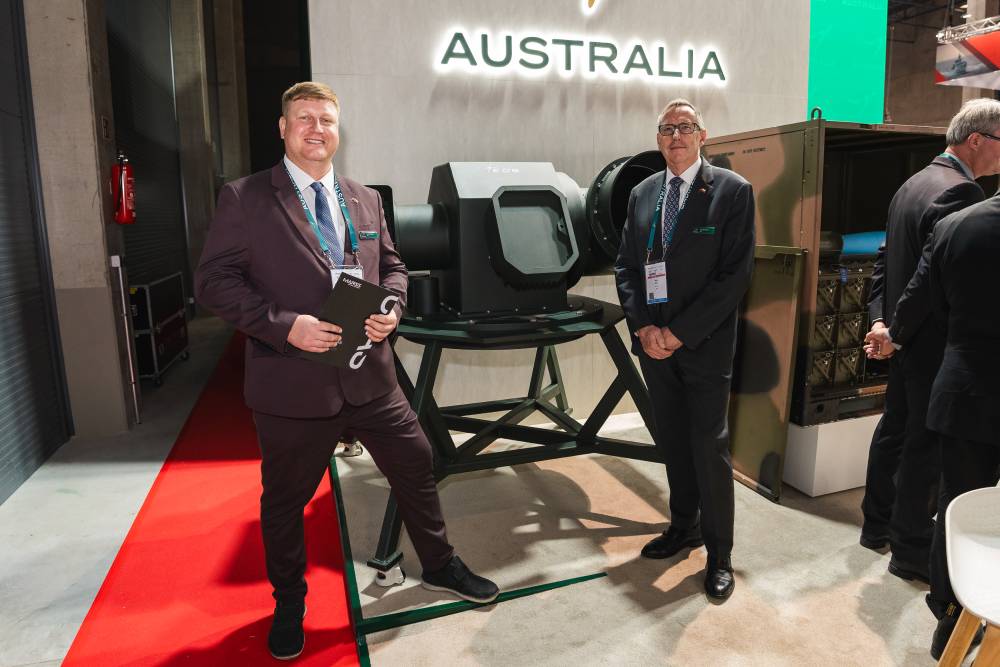
Apollo is the Slinger's "laser" complement, detecting drones at ranges of 50 meters to 15 kilometers and engaging them at ranges of 50 meters to 3 kilometers. The system is effective against Group 1, 2, and 3 UAVs. It is an omnidirectional laser cannon that rotates, locks on to the target, and initiates an attack in less than 1.5 seconds. Tests have shown that the system can "shoot down" more than 20 Group 1 drones (weighing up to 900 grams) per minute.
The Apollo laser cannon has no limit on ammunition capacity or the number of targets it can engage when connected to an external power source. Using its internal power supply, the system is capable of over 200 kills. The cost of a single shot is estimated at less than 10 cents. The entire system can be easily transported in a standard twenty-foot (6-meter-long) container, and it can be ready for operation from a marching position in less than two hours.
The Apollo laser can be seen during MSPO at the Team Defence Australia stand in the Australian Pavilion.