
22 October 2026
26 June 2026
MARSS is a British technology company that specializes in AI-powered security, surveillance, and drone defense systems through its proprietary NIDAR platform. In May of this year, it was acquired by the Australian company Electro Optic Systems (EOS), with which it had already had a long-standing partnership (-> With MARSS, EOS is strengthening its position in the counter-UAS market).
EOS’s Defense division develops technologies for optimizing and integrating weapon systems and reconnaissance systems. Its core products include, among others, remotely controlled weapon systems, vehicle turrets, high-energy laser weapons, and modular drone defense systems.
Put simply, the acquisition will result in the integration of hardware and software. This will create a provider of“turnkey” drone defense solutions for both military and civilian applications.
60 systems in use worldwide
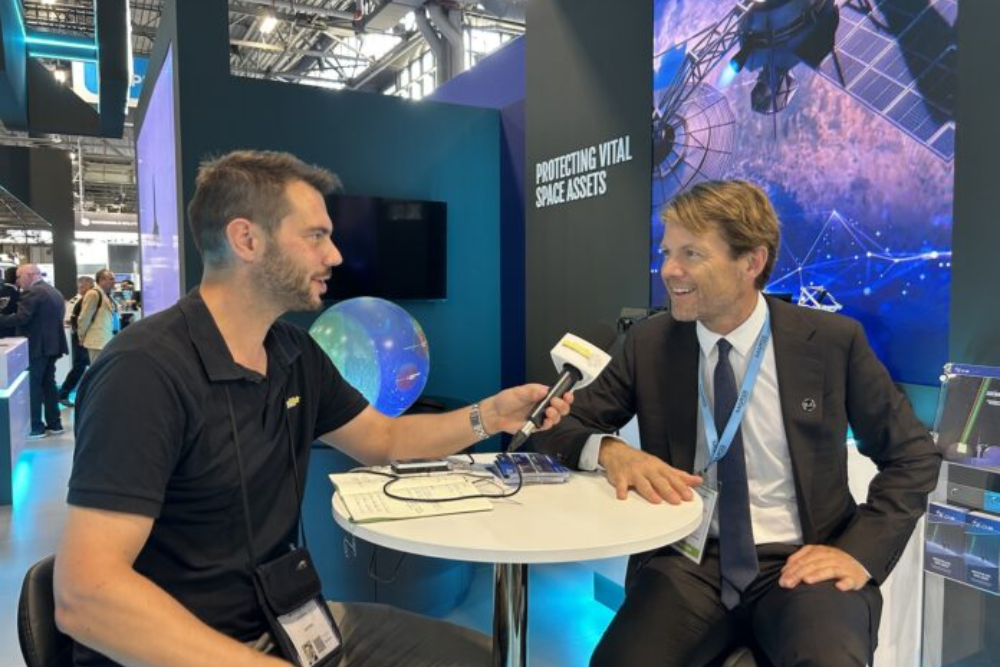
At the Eurosatory 2026 defense exhibition in Paris, Militär Aktuell met with founder and CEO Johannes Pinl, who, incidentally, was born in Austria. His London-based company has been in business for a good 15 years. Speaking about the solutions currently in use, he says: “We have about 60 installations worldwide, primarily in the Middle East.” At the heart of the technology is a highly integrated, automated chain of action known as the “Automatic Kill Chain.” This ranges from initial radar detection at a distance of up to 20 kilometers, through verification using electro-optical infrared cameras, to the final classification and computer-assisted engagement of the target.
Human on, instead of in the Loop
When detecting targets, the system uses artificial intelligence to determine whether it is a commercial drone, a quadcopter, or a larger attack drone, such as a Shahed. However, in light of modern tactics such as highly saturated swarm attacks, the human factor in airspace surveillance is increasingly reaching its limits. “The ‘human-in-the-loop’ concept is no longer realistic in this case. After all, a human cannot keep track of more than four to five drones at the same time,” says Pinl. For this reason, the system architecture is technically designed as “Human on the Loop,” in which sensor detection and the initiation of countermeasures are fully automated, while the human operator primarily monitors the situation from the command post.
The MARSS platform functions as a multi-domain system and consolidates sensor data from the air, the surface, and underwater into a single situational picture. Sonar sensors can be used to specifically identify maritime threats. “The sensors can distinguish, for example, between divers and mini-submarines,” adds Pinl. In addition, the system enriches the display with open-source intelligence (OSINT). This allows for the automated retrieval of background data on ships in the maritime domain to assess their history and the ports they most recently visited.
Cost Control in Drone Defense
One feature of the software focuses on the economic aspect of drone defense, known as “cost per kill.” Based on criteria such as range, collateral damage, and cost, the system suggests the three optimal effectors to the operator. “This prevents low-value threats from being countered with disproportionately expensive means, such as a Thales LMM missile costing 200,000 euros per shot against a simple quadcopter,” Pinl explains. “The operator simply has to decide which effector to use.”
Laser weapon with “free” ammunition
To minimize the long-term operating costs of the defense system, MARSS and EOS are relying on high-energy lasers. An initial system delivered to the NATO will go into production in 2027 and, with a range of up to 2.5 kilometers, requires an irradiation time of about one and a half to two seconds on the drone. “This is a cost-effective solution because a shot costs virtually nothing,” explains Pinl, referring to the relatively high acquisition costs of a laser cannon—unveiled at Eurosatory under the name Apollo. These costs are expected to be in the double-digit millions. The fuel costs alone for the integrated generator are estimated to be only one to two euros per shot.
Interceptor drones without explosives
Newly developed interceptor drones serve as another defense method. These electrically powered defense drones are stored in containers, ready for deployment, and destroy the approaching drone through a targeted collision at a speed of 400 kilometers per hour. Since they contain no explosives, they can be safely positioned near populated areas or infrastructure such as power plants or airports.
“The first Interceptor drones are scheduled to be delivered to the first customer in the Middle East in the coming months. The combination of integrated AI and an infrared camera achieves a hit rate of 98 percent,” said Pinl.
The global defense market is currently driving extensive expansion at EOS, as a result of which the number of employees is expected to triple this year. MARSS recently new office in Nice, France, and another in Germany is also planned.
Collaboration with BAE Systems
In addition to this expansion of its workforce, the company is pursuing strategic partnerships and announced at Eurosatory its exclusive collaboration with BAE Systems in the field of drone defense.
MARSS provides the AI-powered NIDAR command-and-control (C2) platform for the BATS (BAE Systems’ Anti-Threat System) drone defense system. NIDAR acts as an “intelligent nerve center” that integrates all sensors and effectors regardless of manufacturer. By automatically detecting, classifying, and countering asymmetric threats, it shortens the decision-making cycle, which is also intended to provide protection against coordinated swarm attacks.
This article first featured in Militär Aktuell