14 September 2026
05 June 2026
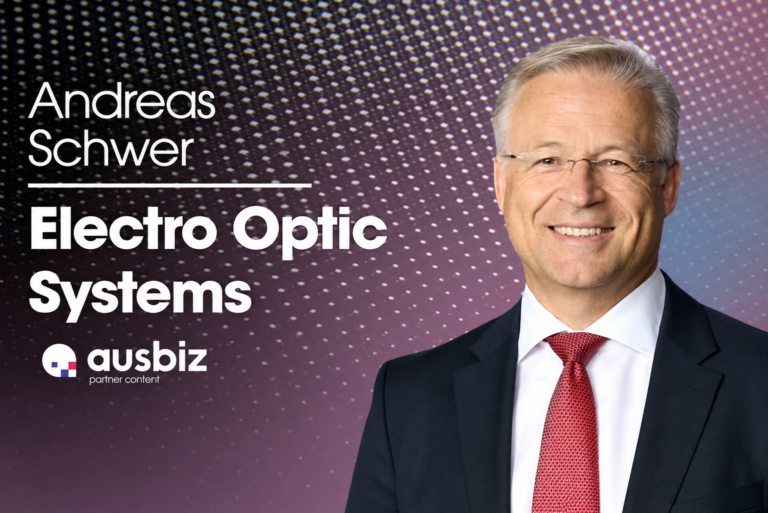
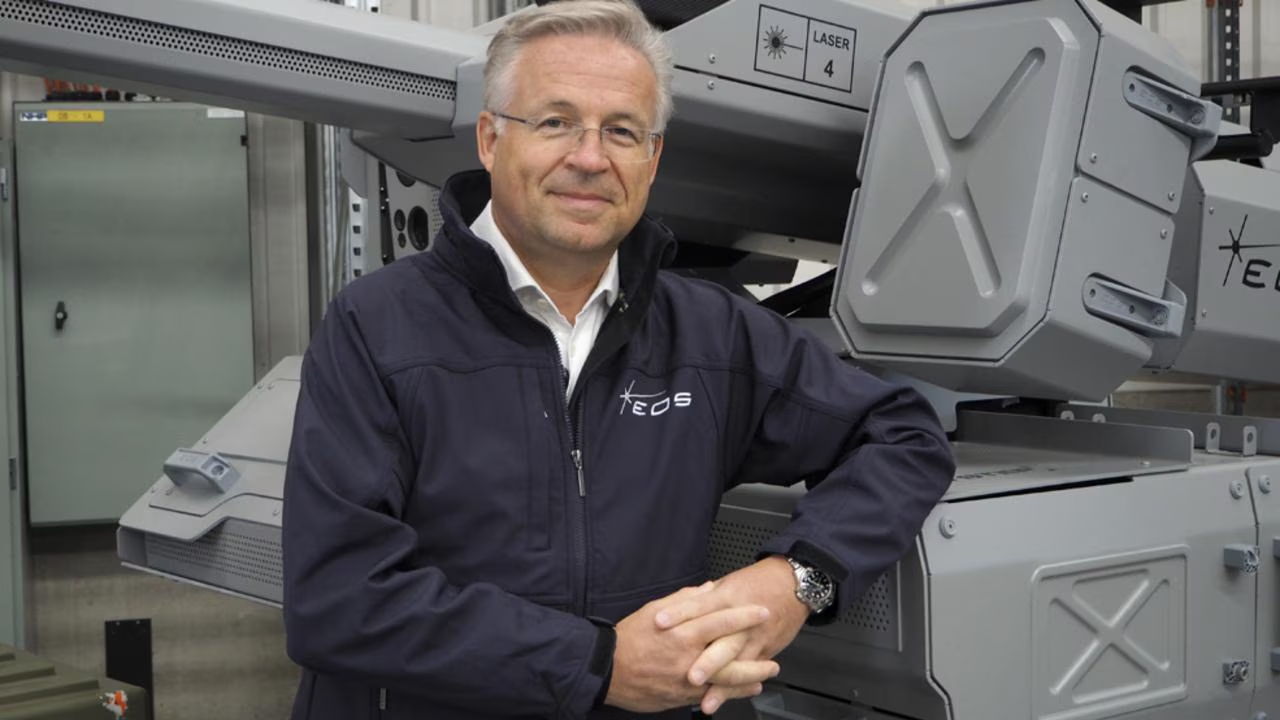
“The first shot matters, because many times you don’t have a chance for a second or third shot,” says Dr Andreas Schwer, chief executive of Canberra-based Electro Optic Systems.
For Schwer, success comes down to one thing: accuracy.
“That is the key discriminator,” he says. “Our advantage comes from our electro-optical sensor unit, which is derived from the tracking capability we originally developed for space applications.
“And the second element is our (fire control) software, which is much more sophisticated than any other competitor.”
EOS Defence Systems’ electro-optical sensor “smarts” come from its space industry roots.
The company was heavily involved in Space Domain Awareness: it tracked satellites and tiny pieces of space debris thousands of kilometres from Earth. Accuracy and sensitivity were vital.
“We realised that with minimum R&D and development effort, we could create a new product category: Remote Weapon Stations,” Schwer says.
“One of our first clients was the US Army, and by the late 1980s, we had become a key supplier.”
An RWS consists of a weapon system – anything from a 7.62mm machinegun to a 30mm cannon, 70mm rockets or even a missile – with an electro-optic sensor unit that tracks targets very accurately and a software-based fire control system.
The company has never lost a single competitive shootout, Schwer says.
“Accuracy has always been our defining advantage,” he says. “It was considered a very attractive proposition without spending lots of internal money – and that’s the reason why we went into that domain.
“You have to understand, with SDA you can’t make that much revenue; in particular, not during those early days.”
‘We want to become one of the world’s leading laser weapon providers, and I believe we are already there.’
Dr Andreas Schwer, chief executive of Canberra-based Electro Optic Systems
EOS began life as a spin-off from the laser physics laboratory of the CSIRO (this year it celebrates its 40th birthday as an independent company) and was headed by renowned laser physicist Dr Ben Greene until, in August 2022, Schwer, now 59, became chief executive as Greene’s successor. Now, after navigating a difficult period in the early 2020s, he has repositioned the company around three major pillars.
“First is the anti-drone business. We want to become the global leader in the anti-drone capability,” he says.
“Second is the high-energy laser weapon business. We want to become one of the world’s leading laser weapon providers, and I believe we are already there. We are the only company to have signed a 100kW laser weapon export contract.
“The third pillar is the evolution of our space capability from space domain awareness into space warfare.”
Basically, Schwer says, the company’s lasers can shift or destroy debris and blind or destroy satellites.
EOS, a publicly listed company, last year had revenues of $128m, and this year, according to analysts, it is expected to generate revenues of more than $240m. It has a workforce of about 550.
The company recently secured major Australian contracts to supply its R400 RWS for the army’s 211 Boxer Combat Reconnaissance Vehicles and 129 Redback Infantry Fighting Vehicles. However, exports remain the dominant driver of the business. Last year, EOS Defence Systems generated about $115m in revenue, largely from export sales to Europe, North America, the Middle East and Asia.
“Around 90 per cent of our revenue comes from export markets,” Schwer says.
“The United States of America – particularly the US Army – remains one of our most important customers. Another major customer is the government of the United Arab Emirates, and in Europe we have multiple clients, most notably the Netherlands and Germany.”
In late May, the company concluded the purchase of MARSS, a Europe-based provider of AI-enabled counter-drone command-and-control systems. It is especially active in the Middle East, Schwer says.
“The company has more than 60 operational installations actively defending high-value infrastructure across the region against Iranian drones and missiles,” he says. “Over the past two months, the operators have successfully intercepted hundreds of Shahed drones and dozens of missiles and rockets.”
Schwer, who was born in Germany’s Black Forest, holds master’s degrees in aerospace engineering from Stuttgart and in systems engineering from the Technical University in Delft. He later did a PhD in satellite engineering while working at the European Space Agency. So he’s an engineer: “As my wife says, the more boring type of man!”
In 13 years with Airbus, he became one of the architects of the Galileo navigation satellite program, before going on to serve as chief engineer of the helicopter division, then leader of Airbus’s defence electronics division.
He later worked for Rheinmetall in Germany – “I was the guy who brought the Boxer to Australia” – before working on defence industry development directly for Mohammed bin Sultan, the crown prince of Saudi Arabia. And that’s where he met Ben Greene.
Schwer believes much of EOS’s future lies in its RWS and HELWs.
“Both are effectors that complement each other well within integrated, multi-layered air defence systems,” he says. “We believe the demand will continue to grow.”
The company has seen a significant increase in orders as a result of geopolitical tension, and not just in Ukraine and the Middle East.
“We expect Europe to be our biggest growth market in the future, followed by the Middle East, where the current conflict is driving a substantial increase in order intake over the coming months and years,” he says.
This article first featured in The Australian written by GREGOR FERGUSON.